When optimizing our website content for search engines, it's possible to fall into the temptation (a legacy of old SEO practices that should no longer be used) of wanting to try tactics that supposedly should help improve the semantic relevance of our content, and therefore facilitate its ranking among the results of Google and other search engines.
These supposed tactics or "SEO tips" can usually be found on black hat SEO blogs and/or forums, which promise to reveal tricks for quickly improving organic search engine ranking. One of these practices is what's known as "keyword stuffing," or the excessive use of (irrelevant) keywords.
While it's true that certain black hat SEO practices can bring certain (even large) short-term benefits (or long-term benefits, depending on how skillful the webmaster is at hiding their tracks and hindering Google's pattern detection), keyword stuffing has proven to be an outdated SEO tactic that can damage a website's visibility and organic ranking.
What is keyword stuffing?
According to the definition we can find in the Google Search Center, the keyword stuffing is «The practice of filling a web page with keywords or numbers with the intention of manipulating a site's ranking in Google search results«.
This essentially means that the same target term (keyword) is frequently repeated on a web page, with the aim of increasing its relevance within the totality of words on the page (what is usually called "keyword density") and obtaining a better SEO ranking for that term in search engines.
While this practice is not as popular as it was a few years ago, it is not uncommon to find websites that still use it to try to increase their visibility in search results.
The traditional way of doing keyword stuffing involves the unnecessary repetition of words or phrases (often out of context or irrelevant to the rest of the page content).
Instead of using variations and synonyms of the keyword for which we are writing the content, in accordance with the use of natural language processing and semantic markup as is advisable; those who use the practice of keyword stuffing to write their content will repeat the same search term many times (especially in the first paragraphs), in order to have a high density for that keyword.
What is keyword density?
Keyword density in SEO is the percentage of times the search term you want to rank for is used, relative to the total number of words in the content.
Keyword density = (number of repetitions of the word in the text) / (total number of words in the text)
For example, let's imagine we are supposedly optimizing a 500-word piece of content using the keyword stuffing technique to improve the relevance of the search term "best SEO website" and we repeat that keyphrase 40 times throughout the text.
In this case, the keyword density is 8% (40/500). Although there is no exact or ideal number for the appropriate keyword density, it is generally considered good practice to stick to a keyword density of around 2% and to use synonyms or variations of the main term when it is necessary to repeat it.
In addition to the practice I just described, there are also other types of keyword stuffing, very typical of the black hat tactics that were used (many) years ago and that are now a guarantee of penalty by Google and other search engines, which have long known and know how to detect these further forms of attempted manipulation.
One of these tactics involves hiding keywords from readers, making them visible only in the page's HTML (so that only search engine crawlers can read them), for example by writing text using the same color as the background.
Another form of keyword stuffing is the repetition of text in the page code, particularly in the meta tags (before using the meta keyword, which Google has ignored for more than a decade) and in the alt attributes of the images.
Why is keyword stuffing harmful to a website?
One of the most obvious reasons why this practice is inconvenient and why search engines dislike it so much is that it creates a truly terrible experience for users (and we know that Google values UX/UI (from one page at a time).
The purpose of a website's content should primarily be informative, add value, and help the user in the decision-making process (including the purchasing process).
If we fill the content with the same keywords repeated over and over, we're not achieving our goal. This often happens when a copywriter (or whoever writes the content) stops writing for their readers and starts writing for search engines.
This not only creates a poor user experience, but will likely also lead to an increased page bounce rate, resulting in a general decline in visit quality metrics.
Furthermore, since keyword stuffing is a practice widely condemned by search engines, writing content in this way could lead to a penalty, with dire consequences for the domain (or at best, for the URL whose content has been written following this harmful practice), which could even disappear completely from the SERPs.
Perhaps at this point you're wondering, "So, how do I use keywords correctly in content?"
How to optimize SEO content?
If what we want is to optimize the content of a page to rank for a specific keyword, the first thing we have to do is understand the concept of "semantic SEO" and stop focusing solely on one keyword, but instead write our content with the aim of making it "«useful with lots of information and that use keywords appropriately and in context«", just as Google suggests.".
To do this, we will have to forget about repeating the keyword we are interested in ad nauseam, and instead use synonyms, variations, and related terms that fall within the same semantic scope as the main keyword, with the dual objective of:
- Write the content in a natural, informative, and reader-friendly way.
- to encompass a wider range of keywords, taking advantage of the semantic correlations between terms
Although there are no fixed rules to follow, these tips that I mention below are a good starting point for writing more SEO-friendly content.
Use secondary keywords, synonyms, variations, and long-tail keywords in the text
When writing page content, don't focus solely on one keyword, perhaps guided by its search volume, but use synonyms and variations, including long-tail keywords with lower monthly search volume (provided they are relevant, of course).
It's also important to consider using semantically related terms, even if they don't have a strict correlation with the main keyword, as it's common for them to be mentioned. If you look closely, you'll see that Google already does this in the "Related Searches" section, suggesting terms related to the query performed.
For example, searching for "keyword stuffing" on Google, the related searches shown are:
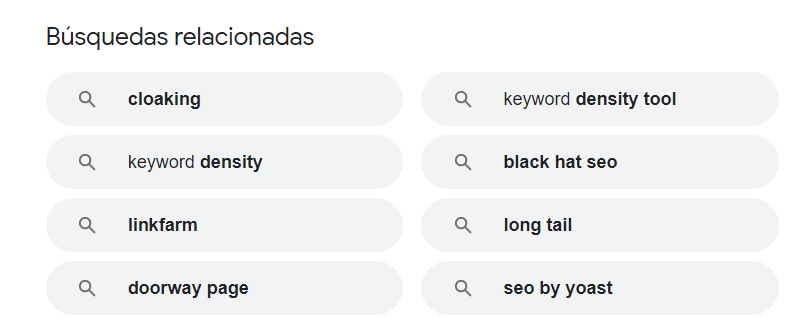
As we can see, Google indicates terms related to "cloaking" (another black hat technique, which has a multitude of uses, in SEO and SEM), "black hat seo" (precisely, making a clear correlation between the keyword stuffing tactic and that aspect of search engine optimization) and other user queries that could be related to the main topic.
Take advantage of all the main elements of the page
Google and other search engines consider certain elements of the page as privileged and use them to interpret the content and categorize it (or rather, index it) in the best way, so as to return it in SERP when a query is made for which our content satisfies the user's search intent.
It is therefore highly advisable to use the keywords (once again, including variations and synonyms) in the following places:
- Page URL
- Page title
- Headers
- Image alt tag (provided it is descriptive)
- First paragraph of the text
- At the end of the content
The meta description deserves separate discussion, as although it no longer has a direct impact on SEO, it is important for CTR optimization (click-through rate).
Optimizing our meta description indirectly affects ranking because it increases the click-through rate for a snippet, a signal that Google interprets as important when deciding whether the result is relevant to the search query (taking into account position and "noise" in the SERP).
You write long content
Search engines aim to provide users with the most relevant and useful information available, and for many search terms your content is more likely to rank well if it is comprehensive and in-depth.
Once again, there is no general rule that applies to all content, since writing a blog post, sales-focused content for a landing page, or a product description with a clear CTA are not the same.call to action, or call to action) to convert the visit.
In general, to write SEO-friendly content, ideally the following should be included:
- be long (depending on the type of content, it is usually in the range of 500 – 1,500 words)
- are structured in sections under hierarchical headings
- Use variations of the main keyword in the text
- Link to other internal pages of the site using interlinking
- satisfy user queries and help retain the visit (time spent on page, bounce rate and number of pageviews per session are important quality metrics that directly influence organic ranking and depend on the quality of the content and its ability to answer the user's search)
Not sure if your content is SEO-friendly? Contact a professional!
If you still have doubts, or if you think you need a content audit of your website performed by a consultant SEO expert, Don't hesitate to contact me by sending me an email or filling out the form.
I would be delighted to help you and put at your service my experience of more than a decade in digital marketing, working for international brands and projects of all kinds.